What Is a Vimana? The Flying Palaces Behind Our Name
By Amit Saini, founder of Vimana Digital · Updated October 2026 · 7-minute read
A vimana is a flying palace or aerial chariot described in Sanskrit literature, including the Ramayana and the Mahabharata, in which gods and kings travel through the sky. In Hindu temple architecture the word also means the tower built over the shrine. Vimana Digital, a web design and marketing agency in Long Eaton, is named after it.
What does "vimana" mean in Sanskrit?
The word is built from vi- ("apart", "through") and the root mā ("to measure"). Its earliest sense is "that which measures out" or "traverses", and dictionaries list a cluster of related meanings: a measure, a chariot, a palace, and the car of the gods that travels through the air (Monier-Williams, Sanskrit-English Dictionary, 1899).
So before it was ever a vehicle, a vimana was the idea of covering distance. That matters for how we use the name, and we'll come back to it.
Where do vimanas appear in the Ramayana and Mahabharata?
The best-known vimana is the Pushpaka, the flying palace in the Valmiki Ramayana. It belonged to Kubera, the god of wealth, was taken by the demon king Ravana, and after Ravana's defeat Rama used it to fly from Lanka back to Ayodhya with Sita and his companions. The text describes it as large enough to carry a whole company of passengers, and it travels at its owner's command.
In the Mahabharata and the Puranas, vimanas belong to the gods: Indra rides one, and the sage Narada travels between worlds in another. The epic also describes Saubha, the flying city of King Shalva, which attacks Dwarka and is eventually destroyed by Krishna. Later Jain cosmology uses "vimana" for the heavenly abodes of celestial beings, and the Buddhist Pali canon has an entire book, the Vimanavatthu ("Stories of the Mansions"), in which people who did good deeds are reborn in shining aerial palaces (Khuddaka Nikaya; translations on SuttaCentral).
Three things stand out when you read the originals rather than the summaries:
- They are described as palaces and cities as often as vehicles: multi-storeyed, decorated with gold and gems, with rooms and gardens.
- They move by will or by the power of the rider, not by any described engine.
- They are almost always a reward or a sign of status. Owning one means you have ascended, literally and morally.
Why is the tower of a Hindu temple also called a vimana?
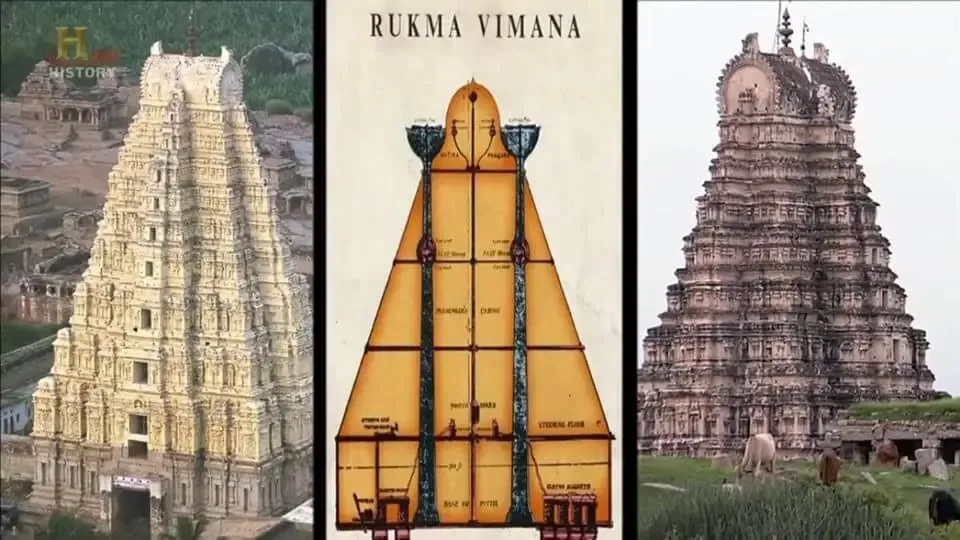
Walk into a South Indian temple built in the Dravidian style and the tallest structure directly over the sanctum (the garbhagriha, "womb chamber") is the vimana. In North Indian Nagara temples the equivalent is a shikhara. The vimana is stepped in tiers that narrow as they rise, usually finished with a dome-like crown and a finial (Encyclopaedia Britannica, "vimana").
The most famous is the vimana of the Brihadisvara Temple at Thanjavur, completed around 1010 CE under the Chola king Rajaraja I. It rises about 66 metres above the shrine, and the temple is one of three on UNESCO's "Great Living Chola Temples" World Heritage listing (UNESCO, inscribed 1987).
The link between the two meanings is not a coincidence. The temple tower is the celestial palace rendered in stone: the god's house, raised towards the sky. The epics describe the idea; the architects built it.
Were vimanas real flying machines? The Shakuna Vimana explained
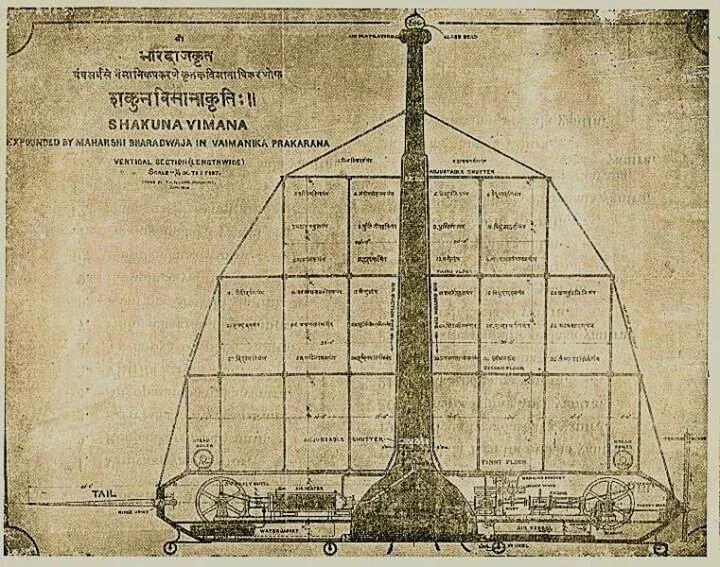
If you search for images of a vimana you will find engineering-style drawings of the "Shakuna Vimana" (bird-shaped craft), the "Rukma Vimana" and others. These do not come from the epics. They come from the Vaimanika Shastra, a Sanskrit text first published in 1952 and said to have been dictated between 1918 and 1923 by Pandit Subbaraya Shastry, with the illustrations drawn by a draughtsman in 1923.
In 1974 a team of aeronautical engineers at the Indian Institute of Science, Bangalore, studied the text and the drawings. Their conclusion was direct: the craft described were "poor concoctions" from an aeronautical point of view, and none could fly (Mukunda et al., A Critical Study of the Work "Vymanika Shastra", Scientific Opinion, 1974).
We mention this because our earlier version of this article leaned on the "lost technology" angle, and it isn't supported. The epics are great literature. The twentieth-century blueprints are not ancient and are not aircraft. Both facts are more interesting than the myth of a cover-up.
What is true is that the word never stopped flying. In modern Hindi, vimān (विमान) is the everyday word for an aeroplane, and "Vimanapura" in Bengaluru is the neighbourhood that grew up around the city's first aircraft factory.
Why is a web design agency called Vimana Digital?
When we founded the agency we wanted a name that stood for lifting things up and moving them forward. A vimana is a vehicle that carries people up and across. Our clients already have something worth seeing: a product, a trade, a clinic, a charity. Our job is to carry it to the people searching for it, and to lift it above the competition in the places that matter, which today means Google, Maps and the AI answer engines as much as a browser.
That is where our tagline, "To Ascend Businesses Online", comes from. It is the name translated into what we do.
The name also keeps us honest. A vimana in the stories is a reward you earn, not a trick. We don't sell guaranteed rankings or shortcuts, and we publish our prices. If you want to know who we are, how we work and what clients say about the experience, the fuller story is on our About Vimana Digital page.
What "ascending" means for a business in 2026
Being visible online now has more layers than it did when the Pushpaka first appeared in print. We work across all of them:
- A website that loads fast, reads well on a phone and tells Google what you do: see web design services and SEO services.
- Appearing in Google's AI Overviews and in ChatGPT answers, not just the ten blue links. Ofcom found about 30% of UK Google searches now show an AI Overview and ChatGPT had 1.8 billion UK visits between January and August 2025 (Ofcom, Online Nation 2025).
- Automating the repetitive parts of running a business so the people in it can do the interesting parts: see AI services.
Everything we offer is listed on our services page. If you'd rather talk to a person, call 0115 647 0444.
Questionspeople askabout vimanas
Not covered here? Call and ask. We reply within 24 hours.
What is the Pushpaka Vimana?
The Pushpaka Vimana is the flying palace in the Valmiki Ramayana. It belonged to Kubera, the god of wealth, was seized by the demon king Ravana, and carried Rama from Lanka back to Ayodhya after Ravana's defeat. The text describes it as a large, jewelled aerial palace that moves at its owner's command.
Is a vimana the same as a UFO?
No. In the Sanskrit epics a vimana is a divine palace or chariot that flies by its rider's will; it is a mythological and literary object. The "ancient UFO" interpretation is a modern idea, and the technical drawings that circulate online come from a text written in the early twentieth century, not from antiquity.
What is the Shakuna Vimana?
The Shakuna ("bird") Vimana is one of several aircraft described in the Vaimanika Shastra, a Sanskrit text published in 1952. A 1974 study by aeronautical engineers at the Indian Institute of Science concluded that the designs in the text could not fly. It is not mentioned in the Ramayana or Mahabharata.
What does vimana mean in temple architecture?
In South Indian (Dravidian) temples the vimana is the tiered tower built directly over the inner sanctum where the main deity sits. It narrows as it rises and is topped with a crown and finial. The 11th-century Brihadisvara Temple at Thanjavur has the best-known example.
Why is Vimana Digital called Vimana?
Vimana Digital is named after the flying palaces of the Sanskrit epics because a vimana carries its passengers upwards. The agency, based in Long Eaton, Nottingham, builds websites, software and marketing campaigns that lift businesses up in search results and in front of customers. Its tagline, "To Ascend Businesses Online", is the name in plain English.
If your website isn't bringing in enquiries, we'll tell you why in plain English and what it would cost to fix.
Get a quote