Bespoke software development company for systems that fit the way you actually work
We build CRMs, operations systems, SaaS products and content management systems around your process, not the other way round. No per-seat licences, no lock-in, and you own the code.
At a glance
- 5.0 from 50 Google reviews
- Up to 48 hours to ~2 minutes (Webro)
- Delivered in 3 weeks after another team's 3-month plan was handed back
Vimana Digital is a bespoke software development company in the East Midlands building custom CRM, ERP, SaaS and CMS systems. You own the code, pay no per-user licence fees, and get a quoted price after a short discovery phase. Simple tools go live in 3–6 weeks; a first CRM or portal release typically takes 6–12 weeks.
- Tools go live in 3–
- 6weeks
- Portal release typically takes 6–
- 12weeks
What we build
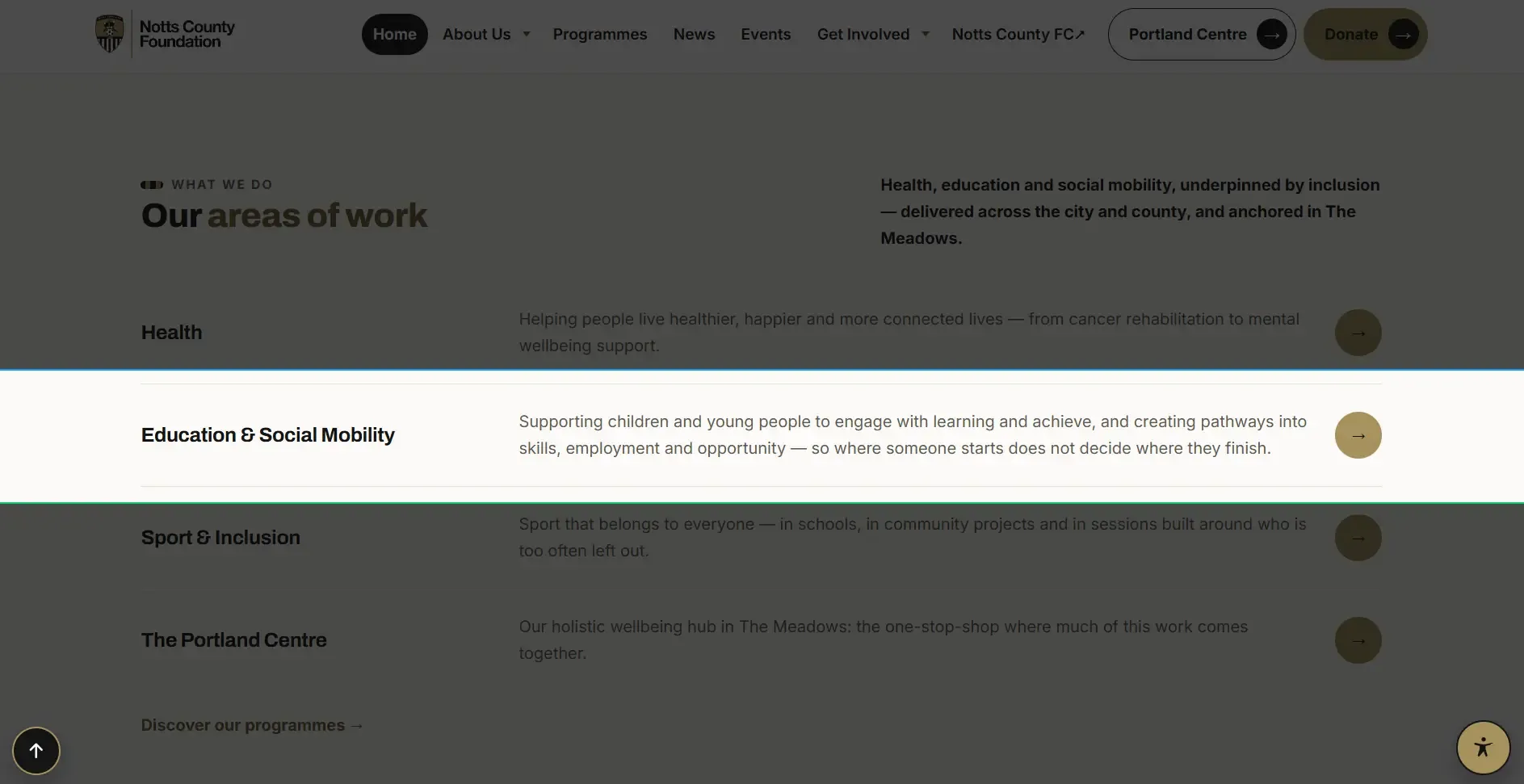
- Custom CRM developmentcontacts, pipelines, quotes, client portals and reporting built around your process, with Xero, Outlook and website forms connected. Proof: Notts County Foundation, LoopCo.
- ERP and operations systemsstock, purchasing, quoting, job costing and dispatch for manufacturers, delivered in phases. To confirm: a named ERP case study
- SaaS product developmentmulti-tenant products with Stripe billing, admin and an API. To confirm: confirm a true multi-tenant SaaS build
- Custom CMS developmentcontent systems built for what you actually maintain, with calculators, bookings, portals and catalogues as modules. Proof: NOPE, Ready Steady Drive.
- AI workflow automationdocument reading, matching and approval flows inside your systems. Proof: Webro.
- Native mobile appsand web development: the front ends your software needs, from the same team.
Should you build, buy or extend?
Most businesses should buy. If HubSpot, Odoo or Xero does 80% of what you need and you have a handful of users, buy it. We'll say so in the first call.
The case for building has got stronger, because licence costs are no longer under your control. Vertice's SaaS Inflation Index hit 16.4% in June 2026, the highest monthly rate it has recorded and almost four times US consumer inflation (Vertice, 2026). In 2025, Salesforce raised Enterprise and Unlimited prices by around 6%, Slack by 20% and Adobe by 16.7% (Salesforce newsroom, 2025; SaaStr, 2025). Per-seat pricing means every new hire is a new licence.
Licence prices you don’t control
Slack, 2025+20%
Adobe, 2025+16.7%
SaaS Inflation Index, June 2026+16.4%
Salesforce Enterprise and Unlimited, 2025+6%
Sources: Vertice, 2026; Salesforce newsroom, 2025; SaaStr, 2025.
0
out of 20
Your score
- 0–5 Buy
- 6–11 Extend
- 12+ Build
0 of 10 answered
The ten-question scorecard. Score 0–2 each: 12 or more suggests build, 6–11 suggests extending a platform you already pay for, 5 or below suggests buy.
1Does an off-the-shelf tool already do 80% of what you need? (yes = 0)
2Is your core process genuinely unusual, or a competitive advantage? (yes = 2)
3Will you have 10 or more paid seats within two years?
4Are you paying for three or more overlapping subscriptions to patch gaps?
5Do you need deep integration with systems the vendor doesn't support?
6Is data ownership, residency or exit a board-level concern?
7Do customers or staff need a portal, mobile or offline use the vendor lacks?
8Can you fund the build in one year rather than spread it as subscriptions?
9Do you have an internal owner who will drive adoption? (no = 0)
10Is the vendor's roadmap or pricing a risk to you?
A five-year comparison (illustrative only). Published list prices and UK agency build ranges; not a quote, and it ignores future price rises.
Read it honestly: Odoo wins on price for a standard process, and bespoke beats HubSpot Professional from roughly year three. The scorecard usually decides, not the arithmetic. To confirm: Vimana to confirm its own build band
Cumulative cost, 15 users
- HubSpot Sales Hub Professional, £85 per seat/month£76,500
- Salesforce Sales Cloud Core, £156 per user/month (salesforce.com/uk, 2026)£140,400
- Odoo Standard, £22 per user/month after year one£19,080
- Bespoke CRM: £25,000–£40,000 build + £3,000–£6,000/year support (UK agency ranges, 2026)£40,000–£70,000
Not sure how you'd score? Send us the process and the subscriptions you pay for. We'll score it with you, and the answer might be "keep what you've got".
Get a quoteSystems we've built
Notts County Foundation
After proposals from several agencies, the official charity of Notts County FC chose us for one joined-up build: a new PHP platform, a bespoke CRM, donation software that reduced reliance on subscription plugins, and an accessibility widget we coded instead of a generic overlay, all to WCAG 2.2. Vimana is now an official partner of the Foundation. Case study →
"They cut through the jargon, simplify the complexities and bring a genuinely open and transparent approach… quickly becoming a trusted partner in making our website more engaging and accessible to all."
Webro Cables & Connectors
A bespoke AI agent that reads emailed purchase orders, matches customers' part numbers to Webro's references and prepares a quotation for human approval. Up to 48 hours became around two minutes, delivered in three weeks. Case study →
LoopCo
A custom CRM that creates client campaigns, links QR codes to destinations, captures engagement and reports to each client through their own CRM access. Case study →
NOPE (No Plastic Ever)
A bespoke PHP site with a custom CMS panel and a bespoke emissions calculator. Case study →
Ready Steady Drive
Online lesson booking with payment and a booking-management CMS covering bookings, customers, payments and lesson options. Case study →
Also: trade login for Ultrabond Adhesives; a 6,000-product code-searchable catalogue for AB Components / Donaldson Filters. Browse all case studies.
How a bespoke software project runs
At handover: source code in a repository you own, database and hosting accounts in your name, admin documentation, an open-source licence list, and training recordings, all assigned to you on final payment.
- 1Discovery (1–2 weeks)We map the current process with the people who do it, find the exceptions, and agree what version one must do.
- 2Written specification with screensYou see every screen and data field before we quote.
- 3Fixed price, or priced sprintsFixed-price per phase; larger systems run in two-week sprints with a demo at the end of each.
- 4Build and demoWorking software every fortnight, in a test environment you can log into.
- 5User acceptance testingYour team tries to break it with real data before go-live.
- 6Go-live in phasesFirst module live early, then the next.
- 7Handover and supportDocumentation, training, a warranty period, then optional monthly support.
Why do software projects go over budget?
Panorama Consulting's 2026 ERP Report (170 organisations) puts the median project at nine months, with more than a quarter over budget. The leading cause was "the unexpected need for additional technology": misfits between system and process surfaced late, so teams bolted on extra tools and scope (Panorama, 2026). Gartner's 2024 research, as reported by ERP Software Blog (2025), predicted that by 2027 more than 70% of recently implemented ERP initiatives would fail to fully meet their original business case.
Panorama Consulting, 2026 ERP Report
9 monthsmedian project
1 in 4+over budget
“50–75% of ERP projects fail”
You will see "50–75% of ERP projects fail" on competitor pages. The 2026 data doesn't support it, so we don't use it. What the research does support is process-first discovery and phased delivery:
Misfits are found in discover
When a change costs an hour of conversation rather than a rebuild.
Fixed price per phas
So scope is a decision, not a drift.
Go live in modules
Panorama found more than a quarter of organisations now use a phased, hybrid approach.
Measured baselin
So success is a number.
Webro is the example: a brief previously taken on elsewhere with a three-month delivery expectation and handed back, delivered in three weeks because the problem was understood first.
Expected elsewhere3 months
Delivered by us3 weeks
Making Tax Digital, UK GDPR and security: what a bespoke system must handle
Making Tax Digital
MTD for Income Tax became mandatory on 6 April 2026 for sole traders and landlords with qualifying income over £50,000, dropping to £30,000 from April 2027 and £20,000 from April 2028 (GOV.UK, 2026). For VAT, HMRC's MTD API requires software that retrieves obligations, submits returns and sends fraud-prevention headers, then passes HMRC testing (HMRC, 2026). The honest answer most agencies skip: the usual design keeps Xero or Sage as the ledger and connects by API, which satisfies the digital-links rule. Direct HMRC submission is extra scope.
MTD for Income Tax: the threshold falls
The usual design
Integration costs are changing
Xero introduced tiered API pricing from March 2026; a single-business integration fits the free tier, but a SaaS connecting many customers' Xero accounts does not (Apideck, 2026).
Data protection by design
UK GDPR Article 25 requires "appropriate technical and organisational measures" built in from the design stage, with a Data Protection Impact Assessment where processing is likely to be high risk; the maximum fine is £17.5 million or 4% of worldwide turnover (ICO, 2026). We plan role-based access, two-factor authentication, encryption, audit logs and UK-region hosting at discovery.
- 43%had a breach or attack
- 15%reviewed their suppliers' risk
- 5%hold Cyber Essentials
Your supplier is part of your attack surface
The Cyber Security Breaches Survey 2025/26 found 43% of UK businesses had a breach or attack in the previous year, yet only 5% hold Cyber Essentials and just 15% reviewed their suppliers' risk (DSIT, 2026). Ask any software supplier about this, including us. To confirm: Vimana's Cyber Essentials status — certified, in progress, or not yet; state only what is true
What we build with, and why
- Laravel (PHP 8.3+) for most business systems and SaaSmature and easy for any PHP developer to take over. Laravel 13 shipped in March 2026 with security fixes to March 2028 (Laravel News, 2026). See Laravel development.
- Node.js with NestJSfor real-time and integration-heavy services.
- React and Next.jsfor fast front ends and portals; Angular where your team already uses it.
- MySQLfor transactional data; MongoDB or DynamoDB where the data shape suits them.
- AWS or Azure in UK regions [NEEDconfirm regions, e.g. AWS eu-west-2 / Azure UK South].
- Stripe for payments1.5% + 20p on standard UK cards, Billing from 0.7% of recurring volume (2026).
If your in-house team is a .NET shop, we'll say so.
Got a spreadsheet that's become a system? That's usually where this starts. Show it to us.
Get a quoteWho owns the software, and what if we closed?
You own it
Source code, database, repository and hosting accounts transfer to your business on final payment, with documentation. No per-user licences.
Any competent developer can take over
Mainstream frameworks, documented systems.
During the build
Your business
- Source code
- Database
- Repository
- Hosting accounts
- Documentation
The blue line: the agent releases the code to you if the developer becomes insolvent or stops maintaining it.
Source-code escrow for larger builds
A three-party agreement with an independent agent such as NCC Group releases the code to you if the developer becomes insolvent or stops maintaining it (Pinsent Masons Out-Law).
Support is optional, never a condition
A warranty period, then optional monthly support covering hosting, monitoring, security updates, backups and small changes. To confirm: Vimana to confirm support from-£/month
How much does custom software cost in the UK?
The spread in published UK prices is the lesson: a bespoke system costs what its scope costs.
All figures are other agencies' published prices: To confirm: Vimana to confirm bands for each system type. For the in-house comparison, a permanent UK software developer's median salary was £65,000 in the six months to October 2026 (ITJobsWatch, 2026), before design, product and DevOps costs.
Published UK agency prices, 2026
Starter CRM (single pipeline, one team)
£2,000–£5,000 (Jabu Designs); most common £8,000–£15,000
Team CRM with integrations and portal
£15,000–£35,000 MVP (Softomate); £10,000–£40,000 (Magora)
Multi-module ERP/operations system
£25,000–£250,000+ (Procosoft); most SME builds £40,000–£150,000, phased
SaaS MVP
£25,000–£60,000; full platform £60,000–£250,000+
Custom CMS
£3,000–£50,000 (Intelivita); most business sites £6,000–£20,000
Published rangeMost common
R&D tax relief may apply. Under the merged scheme from April 2024, qualifying R&D (including software and cloud costs where genuine technical uncertainty exists) attracts a 20% taxable credit (ICAEW, 2024). Keeping a record of the technical problems solved during the build helps your adviser's claim. Always take professional tax advice.
Where we work
We're an East Midlands Chamber member; the Webro project came through a Chamber business adviser. Clients across the UK work with us remotely; local clients often prefer discovery in person.
Frequentlyaskedquestions
Not covered here? Call and ask. We reply within 24 hours.
What is bespoke software development?
Bespoke (custom) software is built for one organisation's processes rather than licensed from a vendor. You own the code and data, there are no per-user fees, and the system changes when your business does. It suits companies whose workflow is unusual, integration-heavy, or expensive to run on subscriptions.
How much does custom software cost in the UK?
Published UK agency bands run from about £2,000 for a single-pipeline tool to £250,000+ for enterprise platforms; most small and mid-sized business systems land between £8,000 and £60,000. We quote after a short discovery phase, so you know the cost before any code is written.
How long does a bespoke software project take?
Simple tools go live in 3–6 weeks. A first usable release of a CRM or portal typically takes 6–12 weeks, and larger ERP-style systems are phased over several months with the first module live early. Our Webro AI workflow took three weeks after another team had quoted three months.
Should I buy off-the-shelf software instead?
Often, yes. If a tool like HubSpot or Odoo covers 80% of your needs and you have few users, buy it. Build when your process is a competitive advantage, licence costs scale with seats, or integrations the vendor can't support are essential. Our ten-question scorecard above gives a straight answer.
Is a custom CRM cheaper than HubSpot or Salesforce?
Over time, usually. HubSpot Sales Hub Professional lists at around £85 per seat per month and Salesforce Core at £156; fifteen seats cost £15,300–£28,080 a year before 2025-style price rises. A £25,000–£40,000 bespoke CRM with a few thousand pounds' annual support typically breaks even in two to three years.
Who owns the software once it's built?
You do. On completion the source code, database, repositories and cloud accounts transfer to your business, with documentation so any competent developer can maintain it. There are no licence fees or lock-in, and we can arrange independent source-code escrow for larger systems if you want extra assurance.
Is bespoke software secure and GDPR compliant?
We design to UK GDPR's data-protection-by-design principle: role-based access, two-factor authentication, encryption at rest and in transit, audit logs, UK-region hosting and a DPIA where processing is high risk . The ICO can fine up to £17.5 million or 4% of turnover, so this is built in from discovery, not bolted on.
Can you integrate with Xero, Sage or our existing systems?
Yes. Accounting (Xero, Sage, QuickBooks), payments (Stripe), email and calendars, couriers, Mailchimp and most modern APIs can be connected. Legacy Access databases and spreadsheets can be migrated or linked. Each integration is scoped in discovery and priced as its own line, so you can see what it costs.
Show us the process that doesn't fit your software
A discovery call usually ends with one of three answers: buy, extend, or build. If it's build, you get a written specification and a price before anything is coded.
Author: Amit Saini, founder and lead developer, Vimana Digital. East Midlands Chamber member. To confirm: years in development, any AWS/Azure certifications · Last reviewed: 9 October 2026
- 0115 647 0444
- contact@vimanadigital.com
- Monday to Friday, 8:30am to 6pm
- 1 Union Street, Long Eaton, Nottingham NG10 1HH
"59 minutes after first contacting Vimana with an urgent query about my ailing website, Amit was sitting in my office and working on the problem." — Paul Harvey, Icarus Media, Google review