AI Chatbots for Clinics and Opticians: What They Should Do, and What They Never Should
By Amit Saini, founder of Vimana Digital · Updated 23 October 2026
An AI chatbot for a clinic or optician answers routine patient questions from your own approved information, helps people book, and passes anything clinical, sensitive or complicated to a member of staff. It should say it's automated, never diagnose, and handle health data carefully. Simple tools suit low volumes; custom builds suit busy or multi-service practices.

What would a chatbot actually do for a clinic?
Think about the calls and emails that interrupt your front desk. Most are not clinical. They're questions with a fixed answer that already exists somewhere on your website or in your head.
A well-built clinic chatbot can handle:
- Opening hours and holiday closures, including late evenings and Saturday clinics
- Booking and rebooking, by connecting to your appointment system or by collecting details for staff to confirm
- Which service someone needs, for example eye test, contact lens check or hearing assessment, based on your own descriptions
- Prices for private services, taken from your current price list
- Eligibility questions you've already written answers for, such as who qualifies for a free NHS sight test
- Practical details: parking, accessibility, what to bring, how long an appointment takes
- Out-of-hours enquiries, captured properly so staff can reply first thing
Check a week of your own calls against that list; it is the quickest way to see whether a bot is worth it. It also means patients get an answer at 9pm on a Sunday instead of waiting until Monday.
What should a clinic chatbot never do?
This is the part that matters most for a healthcare business, and where cheap tools often get it wrong.
- Never diagnose or reassure about symptoms. If someone describes a problem, the bot gives your practice's own urgent-care message, written by your clinicians, with the right phone number. It doesn't interpret.
- Never improvise prices, policies or clinical facts. It answers only from content you've approved, and says "I don't know, let me pass you to the team" when the answer isn't there.
- Never take card details in chat. If payment is needed, send a secure payment link instead.
- Never pretend to be a person. Say it's an automated assistant in the first message.
- Never collect more health information than it needs. A booking needs a name, contact details and appointment type, not a medical history.
Do patients actually want to talk to a chatbot?
Mostly, no, and it's worth knowing that before you buy one. UK surveys in 2025 found that 83% of customers prefer a real person and only 4% prefer a bot (8x8), that 61% want a human and only 10% want more AI in customer service (Trustpilot), and that 58% worry they won't be able to reach a person (Qualtrics). All three come from companies with a commercial interest in customer service, so treat the exact figures with some care.
Clinics have an extra reason for caution: patients are often older, anxious, or both. So the design rule is simple. The bot should make reaching a human easier, not harder:
- A visible "talk to the team" option in every conversation
- Automatic hand-over the moment a question is clinical, emotional or outside the approved content
- Office-hours hand-over to live staff, out-of-hours hand-over to a callback request
- The conversation passed across with it, so the patient doesn't repeat themselves
Built that way, the bot isn't replacing your receptionist. It's taking the repetitive questions off their desk.
What do the rules say about health data and chatbots?
Clinic chatbots sit in the most regulated corner of chatbot use. In plain terms:
- Health information is special category data. Under UK GDPR it needs extra protection and a specific legal condition for processing. Assume anything a patient types could include it.
- Fully automated decisions are still restricted for health data. UK GDPR's old Article 22 was replaced by Articles 22A to 22D on 5 February 2026. Solely automated significant decisions are now more widely permitted for ordinary data, but remain restricted for special category data (Data (Use and Access) Act 2025, section 80). A booking assistant is fine; a bot that decides who gets treatment is not.
- You need a data processing agreement with the AI provider, and a business-tier service that doesn't use your patients' conversations to train its general models. We do use conversations to improve your own bot, so your agreement with us and your privacy notice should say so.
- Choose where the data lives. UK or EU hosting where possible, transcripts kept no longer than needed, and access limited to staff who need it.
- Tell people it's AI. The ICO expects transparency about automated processing. If you have patients in the EU, Article 50 of the EU AI Act has required chatbots to make clear that people are talking to an AI since 2 August 2026.
- You're liable for its answers. In Moffatt v Air Canada (February 2024), a Canadian tribunal said a company "is responsible for all the information on its website… whether the information comes from a static page or a chatbot." It isn't binding in the UK, but the logic is hard to argue with.
Your regulator's standards apply to online contact with patients too; for opticians, that means the General Optical Council's standards of practice. Check it before launch.
Off-the-shelf or custom: which suits a practice?
| Off-the-shelf chatbot tool | Custom chatbot built for your practice | |
|---|---|---|
| Typical UK cost (vendor-published, 2026) | £20–£100 a month | From about £1,500 for a simple FAQ bot; £3,000–£25,000 with booking, CRM or WhatsApp integration; £100–£400 a month to run and maintain |
| Set-up | You configure it yourself | Built and tested around your content, hand-over rules and systems |
| Answers from | What you paste in | Your approved price list, policies and service pages |
| Booking | Basic, or via a link | Connected to your appointment system where it allows |
| Data control | Provider's terms | Hosting region and retention agreed with you |
| Best for | One site, low enquiry volume, simple questions | Several services or sites, high volume, booking integration, strict data needs |
Those prices are other companies' published figures (Softomate, Askmind, Expertsure and others, seen October 2026). The honest rule: if your practice gets a handful of website enquiries a week, a well-configured £30-a-month tool is probably enough, and we'll tell you so.
Why does the website come first?
A chatbot can only answer from information that exists and is correct. In most small practices, that information is scattered: prices in a spreadsheet, policies in an email, services described differently on every page.
This is where our clinic work starts, though so far on the website side. We've built websites for two independent opticians, and neither project included a chatbot. What they show is the groundwork a good chatbot depends on:
- The Duffield Clinic, Duffield, Derbyshire: an optician offering eyecare and hearing care, with a separate page for each service and a clear enquiry route on every one.
- Louth Vision Centre, Louth, Lincolnshire: a page for each service from eye tests to hearing care, with all the copy written by us after Amit visited the clinic to take the brief.
A site organised like that, one service per page, written in patients' language, is already most of a chatbot's knowledge base. If your site isn't, fix that first. It helps patients and search engines whether or not you ever add a bot.
What those clinics said about working with us on their websites:
"From when we contacted them, Amit responded almost instantly, he then came to our clinic and took our requirements and the site was built within the time quoted." (Louth vision centre)
"Their web designers created a beautiful and user-friendly website that perfectly represents my brand. Plus, their SEO expertise has significantly increased my online visibility." (Duffield Clinic)
How would we build a chatbot for a clinic?
- 1Listen to reception. A week's log of the questions staff answer most often tells you what the bot is for.
- 2Gather and approve the content. Prices, policies, service descriptions and the urgent-care message, signed off by the practice.
- 3Write the hand-over rules. What always goes to a person, how it reaches them in and out of hours.
- 4Set up data handling. Provider agreement, hosting region, retention period, staff access.
- 5Build and test with real questions, including awkward ones, before any patient sees it.
- 6Launch, then review transcripts. Weekly at first, to catch gaps and wrong answers.
- 7Keep it current. When prices or hours change, the bot changes the same day.
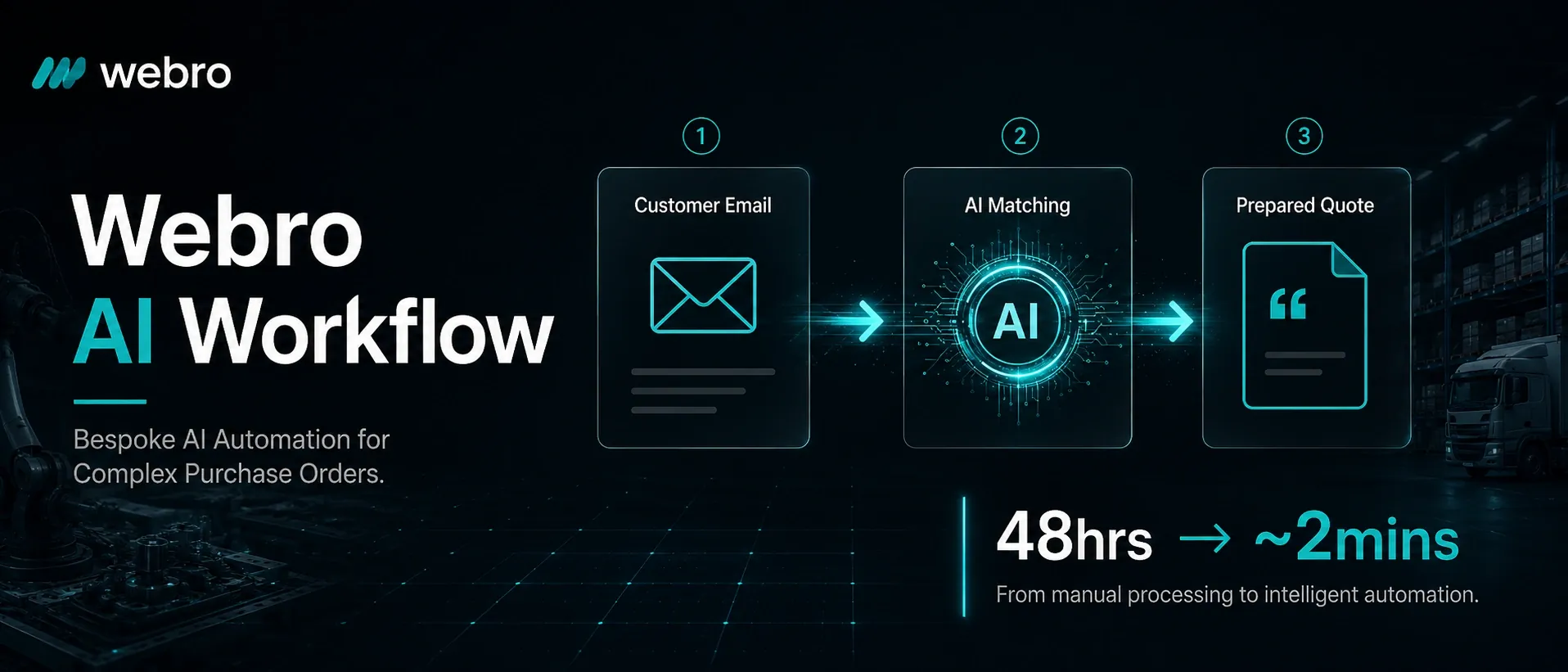
A website chatbot trained on existing content typically takes two to four weeks including testing, and longer when it needs booking or CRM integration. We don't yet have a published chatbot case study. The closest proof is our Webro AI agent, which reads purchase-order PDFs, matches hundreds of line items and prepares a quotation, with a person approving the result before anything is sent. It was delivered in three weeks.
Frequentlyaskedquestions
Not covered here? Call and ask. We reply within 24 hours.
Is an AI chatbot safe to use in a clinic?
It can be, if it's limited to non-clinical questions, answers only from approved content, hands anything clinical to staff and handles health data properly. That means a data processing agreement, UK or EU hosting where possible, short transcript retention and clear disclosure that it's automated. A general-purpose chatbot left to improvise is not safe.
Can a chatbot book appointments for an optician?
Yes, either by connecting to your appointment system, where it allows integration, or by collecting the patient's details and preferred times for staff to confirm. Many practice systems have limited integration options, so we check yours first. Confirmation by email or text reassures patients the booking is real.
How much does a clinic chatbot cost in the UK?
Off-the-shelf tools cost roughly £20 to £100 a month. UK agencies publish custom chatbot prices from about £1,500 for a simple FAQ bot to £3,000–£25,000 with booking or CRM integration, plus £100–£400 a month to run. A single small practice often only needs the cheaper option.
Will patients be put off by a chatbot?
Some will, which is why the human route must always be visible. Surveys show most UK customers prefer people, but they value instant answers to simple questions. A bot that says it's automated, answers the routine quickly and hands over without fuss tends to be accepted. One that blocks access to staff gets resented.
Do we have to tell patients they're talking to AI?
You should, every time. The ICO expects transparency about automated processing under UK GDPR, and for any patients in the EU, Article 50 of the EU AI Act has required disclosure since August 2026. It costs nothing to say "I'm the practice's automated assistant" in the first message, and it builds trust.
Send us a rough list of the questions your practice gets every week. We'll tell you honestly whether a chatbot is worth it, whether an off-the-shelf tool would do, and what your website needs first. For Louth Vision Centre, Amit visited the clinic to take the brief. We visit with no travel charge, though most work happens online by call and screen-share.
Get a quote