Secondary Glazing Derby: A Product-Led Website for a Derbyshire Installer
By Amit Saini, founder of Vimana Digital · First published 10 August 2023 · Updated 23 October 2026
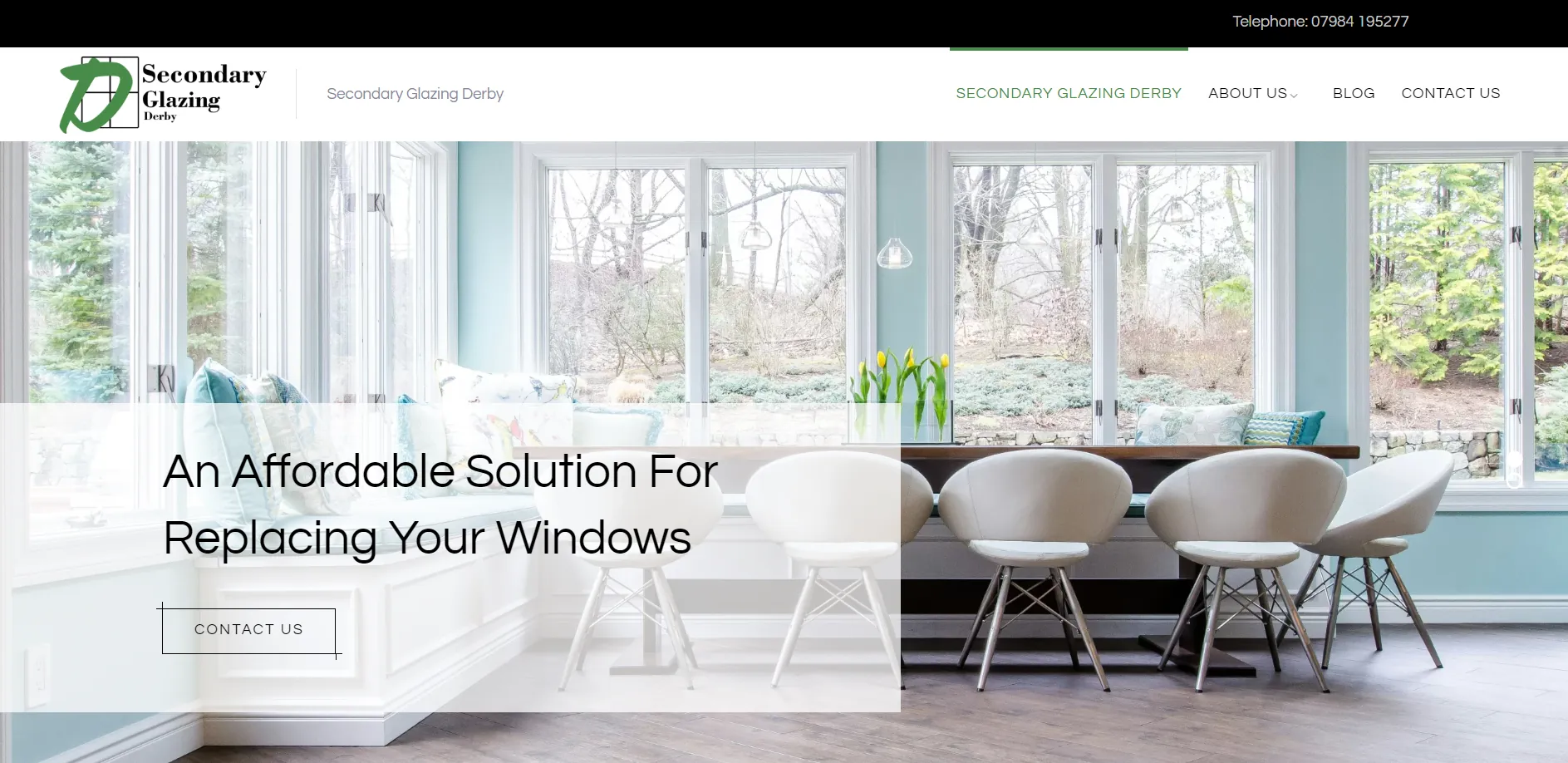
Secondary Glazing Derby is a WordPress website Vimana Digital built for a secondary glazing supply-and-fit installer serving Derbyshire and the East Midlands. It covers horizontal and vertical sliders, hinged, lift-out, fixed and bespoke units, secondary glazing for listed buildings, downloadable product PDFs and clear contact routes, written and optimised for Derbyshire searches.
What did a Derbyshire secondary glazing installer need from a website?
Secondary glazing is a second, independent window fitted inside an existing one. It is the usual answer for listed buildings and conservation areas where replacement double glazing is not permitted, and for homes near busy roads or railways where noise is the problem. Derbyshire, with its mill towns, Georgian terraces and the Peak District villages, has a lot of both.
The installer already had a Leicestershire site, which we built and wrote earlier in 2023 (read that case study). The Derby site needed to do the same job for a different county: act as a digital brochure, be concise but complete on the product range, and target Derbyshire searches rather than Leicester ones. Like the Leicester project, it was built on WordPress with the copy written by us.
The important discipline was not to copy the Leicester site and swap the county name. Each site needed its own pages, its own wording and its own local angle, both for the reader and for Google.
What is on the Secondary Glazing Derby website?
- A page for each unit type: horizontal sliders; vertical sliders with slide-pass and tilt-in options; hinged units in slimline, double slimline, double and tilt-and-turn forms; lift-out units; fixed units; and bespoke and arched units.
- Two range tiers, Classic and Enhanced, so the site can serve both the budget-conscious and the heritage buyer.
- Specification up front: noise reduction, thermal insulation and security benefits, over 200 RAL colours, glazing up to 10.8 mm, and a 10-year guarantee on some products.
- A listed buildings and conservation areas guide under About Us, the page most likely to be found by a Derbyshire homeowner who has just been told they cannot fit double glazing.
- Downloadable PDF product overviews for horizontal sliding, balanced vertical slider, hinged and lift-out units, shared with the Leicestershire site rather than duplicated.
- A blog for ongoing local content, and a phone number, email and Contact Us buttons throughout.
- Coverage stated: the whole of Derbyshire, with links to the installer's Nottinghamshire and Leicestershire sites for customers across the border.
The live site has no quote form or live chat at the time of writing, unlike the Leicester site.
Does a separate website per county work for installers?
It can, with conditions. Three things we weigh:
- Google's doorway rule. Its spam policies list "multiple domain names or pages targeted at specific regions or cities that funnel users to one page" as doorway abuse (Google Search Central). The Derby and Leicester sites avoid that by being different sites with different content for different counties, each with its own enquiry route. If the only difference were the county name, we would have advised one site with county pages instead.
- The Derbyshire market is bigger than the city. Derby has 7,565 enterprises, but Derbyshire outside the city had 29,410 businesses in 2025 (ONS via Nomis, March 2026; Derbyshire Observatory, February 2026). Searches for "website design derbyshire" and "secondary glazing derbyshire" are county-wide, which is why the site says Derbyshire, not just Derby.
- Research-heavy products reward depth. Secondary glazing buyers compare unit types, glass thickness and guarantees before they call. A site that spells those out keeps the customer on the page; one that says "contact us for details" sends them to a competitor who published them.
The Leicester sister site shows what the approach can do. We wrote every word from scratch with an SEO plan behind it, added quick forms, live chat and contact details on each page, and launched in July 2023. Google indexed it within 24 hours. That is the standard we applied to the Derby build: specification-led copy written for the county, not a reworded copy of the Leicester pages.
A fair caveat: two sites means two sets of updates, two WordPress installs to keep patched and two hosting bills. For an installer with real coverage in two counties that is a reasonable cost; for one van covering a 15-mile radius it is not. We'll tell you which you are.
Websites for Derby and Derbyshire trade businesses
This is one of a group of Derby trade sites we've built, with Diamond Alloys, Dirt Detox cleaning and Westminster Building Company among the others. If you're an installer or trade in Derby or Derbyshire, our web design Derby page has local pricing, timelines and the rest of the Derby portfolio. We're 15 minutes down the A52 in Long Eaton.
Want a site that explains your products as well as you do? Call 0115 647 0444 or get a quote. 5.0 from 50 Google reviews.
Secondaryglazing website:common questions
Not covered here? Call and ask. We reply within 24 hours.
Is a secondary glazing website different from a double glazing website?
In structure, no: a page per product, specifications, photos and a clear enquiry route. In content, yes: secondary glazing buyers are often in listed or conservation-area homes, or dealing with traffic and rail noise, so detailed pages on planning rules, acoustic performance and glass thickness matter far more to them than price-led offers.
Should an installer have one website or one per county?
One website with a page per area is right for most installers. A site per county is worth it only when you genuinely operate in each, can give each site its own content, and can keep both updated. Google treats near-identical regional sites as doorway pages, so the content must differ properly.
How long did the Secondary Glazing Derby website take to build?
For comparison, straightforward brochure websites with Vimana Digital typically go live within one to three weeks of the content being agreed, because we write the copy ourselves. The Leicester sister site was indexed by Google within 24 hours of launch in July 2023.
What does a website like this cost?
A product-led brochure site for an installer typically costs £3,000–£6,000 with Vimana Digital, depending on the number of product pages and downloads; smaller sites start from around £1,000. Hosting is from £120 a year with SSL included, and website management from £50 a month paid annually. Prices exclude VAT.
Send us your product list and the areas you cover. We'll come back with a page plan and a price, in plain English.
Get a quote