Shopify SEO Services for UK Stores That Have Outgrown the Theme Defaults
Collections that match how people search, product data Google can use, and the app clutter cleared out. That's Shopify SEO, from a UK ecommerce agency that builds shops as well as ranking them.
At a glance
- 5.0 from 50+ Google reviews
- National SEO £1,000–£4,000 a month
- No long contracts
- Written by Amit Saini, updated November 2026
Shopify SEO is the work of making a Shopify store rank for what its customers search: collection pages that match category searches, tidy internal links around the duplicate URLs Shopify creates, and accurate product data for Google. We run it for UK stores within our national band of £1,000–£4,000 a month, and results usually build over three to six months. One thing up front: we build shops on WooCommerce, Magento and bespoke code, and we take on Shopify builds, but we haven't published a Shopify store of our own yet. The SEO work is the same on any platform; the Shopify-specific parts are below.
- Within our national band of
- £1,000–£4,000a month
- Results usually build over
- 3–6months
We checked 17 UK Shopify stores. Here's what they miss.
On 10 November 2026 we looked at 17 well-known UK brands running on Shopify: fashion, beauty, food and drink, homeware. For each one we read the structured data on one product page and the links on one collection page. These are established brands with real budgets, not hobby shops.
| What we checked | Stores that had it |
|---|---|
| Product markup of any kind on the product page | 15 of 17 |
| Shipping details in the product markup | 1 of 17 |
| Returns policy in the product markup | 2 of 17 |
| Review stars (aggregate rating) in the markup | 6 of 17 |
| A barcode (GTIN) in the markup | 7 of 17 |
| Collection pages linking to products through the longer /collections/…/products/… address | 5 of 15 we could read |
What it means:
- Almost every store has basic product markup, and almost none finish itShopify themes add the basics. Shipping costs, delivery times and returns are what Google can show next to your listing, and 16 of 17 left shipping out of the page. You can also give Google this through Merchant Center, so missing markup isn't a disaster, but it's worth checking which route your store uses.
- A third still use collection-aware product linksShopify points Google at the main /products/ address with a canonical tag, so this won't get you penalised. It does mean every collection page links to an address you don't want indexed, so crawling and link value go to the wrong URL. It's usually a small theme fix.
- Review stars depend on the review appSix stores had ratings in their markup. Others may show stars on the page that Google never reads, because the app doesn't add them to the structured data.
How we did it: one product page and one collection page per store, read from the public HTML on 10 November 2026. A single product isn't the whole store, and some stores may send shipping data through Merchant Center instead. Treat it as a pattern, not a verdict on any brand, which is why we haven't named them.
What Shopify does for you, and what it leaves to you
Shopify takes care of a lot that WordPress and bespoke stores have to arrange themselves. It doesn't take care of everything, and the gaps are where most Shopify stores lose rankings.
Handled by Shopify

- Hosting, SSL and a content delivery network, so the basics of speed and security are covered
- An automatically generated sitemap at /sitemap.xml
- A canonical tag pointing collection-based product URLs back to the main /products/ URL
- Editable page titles, meta descriptions and image alt text on every product, collection and page
- Basic product markup in most themes
Left to you
- Fixed URL prefixesProducts always live under /products/, categories under /collections/ and content under /pages/ and /blogs/. You can't remove them, so your keywords have to work inside that structure.
- Collection-aware linksSome themes link to products through /collections/name/products/name. The canonical tag tidies this up for Google, but your internal links still point at a URL you don't want indexed. A third of the stores we checked do this.
- Filter and tag URLsFilters and tag-based collection views create extra URLs. A few deserve to rank; most don't.
- Thin collectionsMany collection pages are a heading and a product grid. A collection is the page most likely to rank for "women's waterproof walking boots", so it needs more than that.
- AppsEach app can add scripts to every page, and older-style apps can leave code in your theme after you uninstall them.
- Unfinished structured dataAs our check shows, shipping, returns and review details are usually missing.
What our Shopify SEO services include
Collection strategy
We map how people search to how your catalogue is organised, then create, merge or rewrite collections to match. Each priority collection gets useful copy (sizing, materials, who it suits) placed so it helps rather than pushes products off the screen.
Product pages and variants
Unique descriptions for the products that earn most or have the most search demand, specification details, and a clear rule for variants. Shopify keeps variants on one product URL with a ?variant= parameter, which is usually right. Occasionally a colour or size deserves its own product page because people search for it by name.
Theme and internal linking
We check how your theme links collections to products, breadcrumbs and pagination, and fix links pointing at non-canonical URLs. Changes are made on a duplicate theme and previewed before anything goes live.
Structured data and Google Merchant Center
Complete Product and Offer markup, including shipping, returns, barcodes and review stars where you have them, checked in Search Console. Plus a clean Merchant Center feed for free listings. Paid Shopping runs through our Google Ads management.
Apps and speed
An audit of every installed app: what it adds to each page, whether you still use it, and whether a theme feature could replace it. Leftover code from removed apps is cleaned out. We test Core Web Vitals on real product and collection templates, not just the home page.
Crawl control
Shopify lets you edit robots.txt through a robots.txt.liquid template. Shopify's own help centre calls this an unsupported customisation and warns that mistakes can cost you traffic, so we only change it when there's a clear case, keep a copy of the default output and test the result.
International stores and Shopify Markets
Selling into Europe, the US or Australia? Shopify Markets can serve each country from a subfolder (such as /en-us/) and adds hreflang tags automatically. We set up markets, translations and Search Console so each country version reaches the right audience, and we avoid adding a second, conflicting set of hreflang tags through an app.
Links and mentions
Link building is part of every SEO plan rather than an extra: product round-ups, supplier and stockist pages, and digital PR where you have a story. Never bought in bulk.
Content and AI search
Buying guides and comparison pages for the "best X for Y" searches collections can't win on their own, written so AI Overviews and ChatGPT can quote them. See AI search optimisation.
Reporting
Organic orders and revenue by landing page from Shopify and Google Analytics, plus Search Console data, every month.
Six checks you can run on your own Shopify store today
If you'd rather we did this, our free website SEO audit covers all six. A full technical review is available as a paid SEO audit, from about £300 for a small site.
- 1Paste one product page into Google's Rich Results TestLook for shipping, returns and review details under Product. In our check, 16 of 17 stores had no shipping details.
- 2Open a collection page, right-click a product and copy the linkIf it contains /collections/ before /products/, your theme uses collection-aware links.
- 3Open your top five collections on a phoneIs there any text that explains the range, or only a heading and a grid?
- 4Check Search Console > PagesLook for large numbers of "Duplicate without user-selected canonical" or "Crawled, currently not indexed" URLs with filter parameters or tags.
- 5List your installed appsAnd mark the ones you haven't used in three months. Each one is a candidate for removal.
- 6Search for your best-selling product by nameIf a reseller or marketplace outranks you with the same supplier description, your product copy needs work.
Shopify, WooCommerce, Magento or bespoke?
All of them can rank. Shopify is simpler and fast by default but fixes your URL structure. WooCommerce gives full control at the cost of more maintenance. Magento handles big, complex catalogues. A bespoke build suits very large or specialist ranges. Our ecommerce SEO page compares them in detail.
Straight answer on what we do: we design and build shops on WooCommerce, Magento and bespoke platforms, and we'll build on Shopify too, though we haven't launched one yet. We optimise existing Shopify stores without rebuilding them. Thinking of moving platform? Read website migration SEO first.
How much do Shopify SEO services cost?
Shopify SEO sits within our national SEO band of £1,000–£4,000 a month, because most Shopify stores sell UK-wide or further. A single-category store with a few hundred products can start near the bottom of the band. A store with thousands of products, several Shopify Markets or an active content programme will sit higher. Prices exclude VAT.
Contracts are rolling monthly with one month's notice. Technical and structured-data fixes usually show in Search Console within weeks; collection rankings and organic revenue typically build over three to six months. We review strategy with you every 90 days. You own the content, the accounts and the data, and if you leave, everything goes with you.
Prefer a Shopify SEO consultant?
If you have an in-house team or developer and want direction rather than delivery, see our freelance SEO consultant option.
Should you trust a Shopify SEO guarantee?
Some Shopify SEO agencies guarantee a revenue target. Read the small print before it sways you. A guarantee usually means fees are refunded, or work continues free, if a target is missed, and the agency sets the target from its own forecast. It doesn't change what Google does. Google's own guidance says no one can guarantee a #1 ranking.
What you can reasonably ask for instead: a written plan for your store, a forecast with its assumptions shown, and monthly reporting on organic revenue, not just rankings. That's what we give you.
How a Shopify SEO campaign runs
To work on your store you add us as a staff account with only the permissions we need, so you never share your own login and can remove us at any time.
- 1AuditWe crawl the whole store, including filter and tag URLs, and review Search Console, apps, theme, structured data and Merchant Center.
- 2Map search to catalogueKeyword research by collection and product type, with a list of collections to create, merge or rewrite.
- 3Fix the platformTheme links, structured data, app clean-up, speed and crawl control, in the first six to eight weeks.
- 4Write and publishCollection copy, priority product descriptions and buying guides, every month.
- 5Feed Google ShoppingMerchant Center set up or cleaned, free listings live, disapprovals resolved.
- 6Report on revenueOrganic orders and revenue by landing page monthly; strategy reviewed every 90 days.
Our ecommerce work, honestly stated
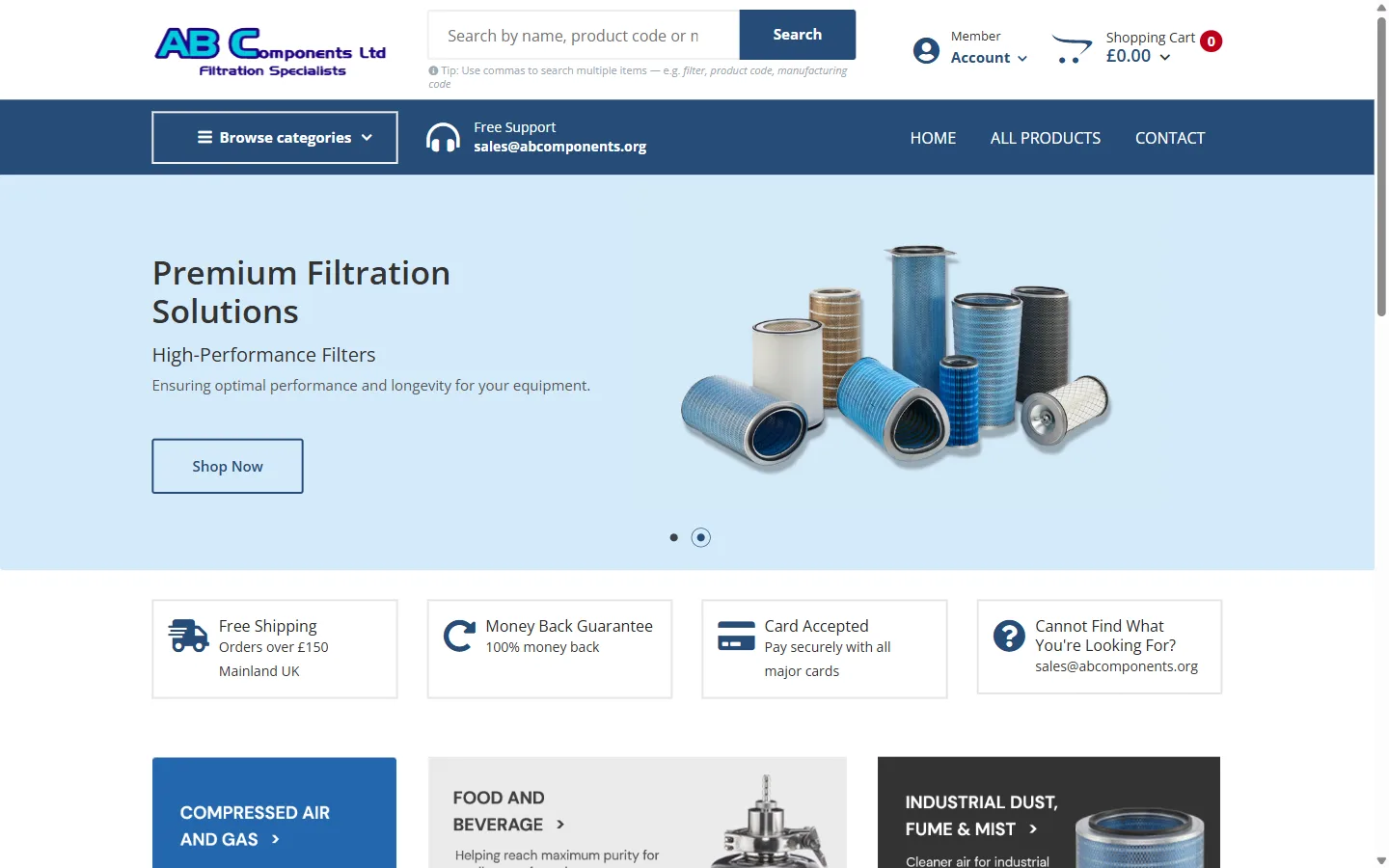 AB Components, Donaldson Filters storeA dedicated store with 6,000+ products, searchable by keyword, product code and manufacturing code.
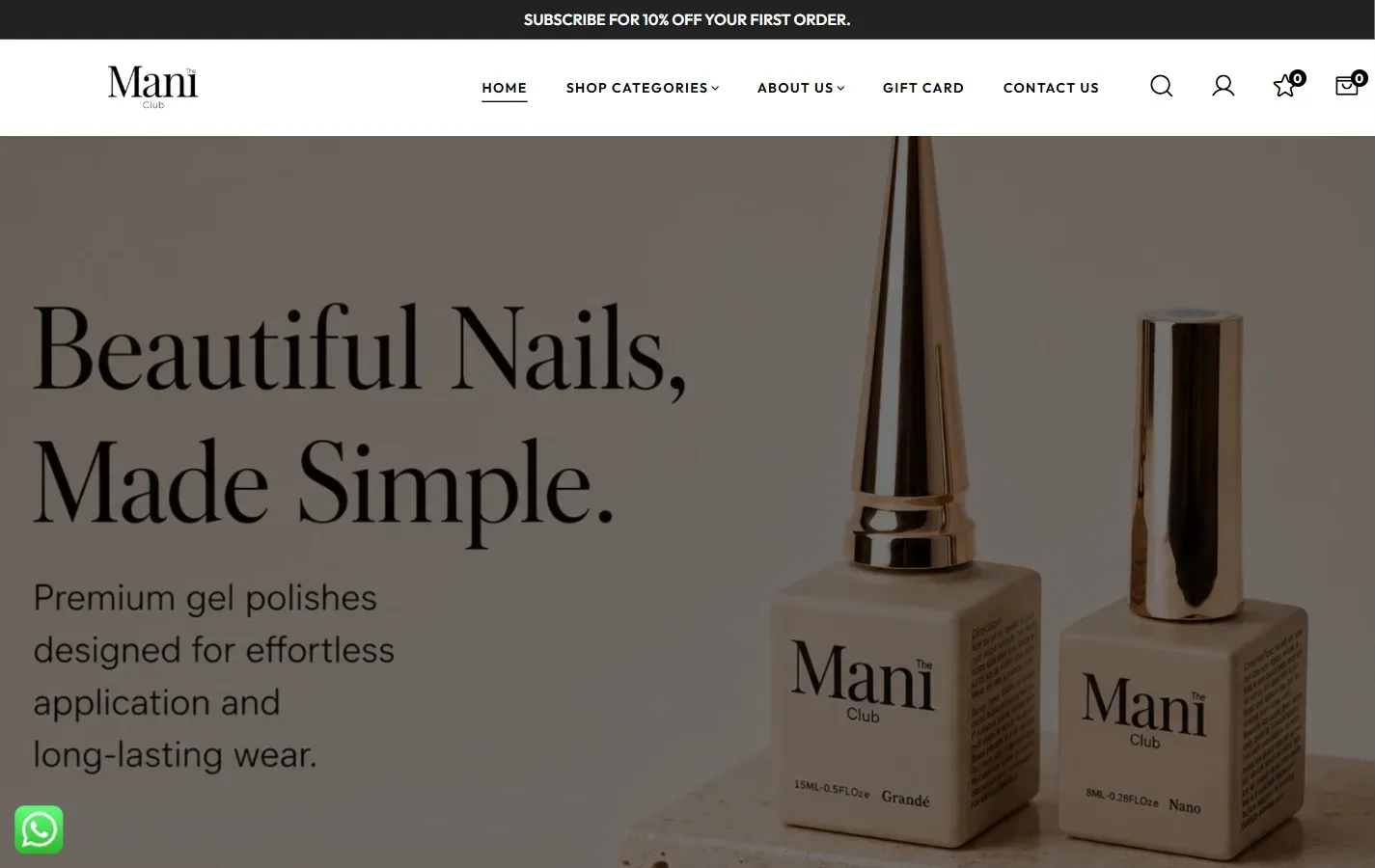 The Mani ClubA UK gel polish supplier selling worldwide; we planned the product and page structure for an international SEO campaign and wrote every page.
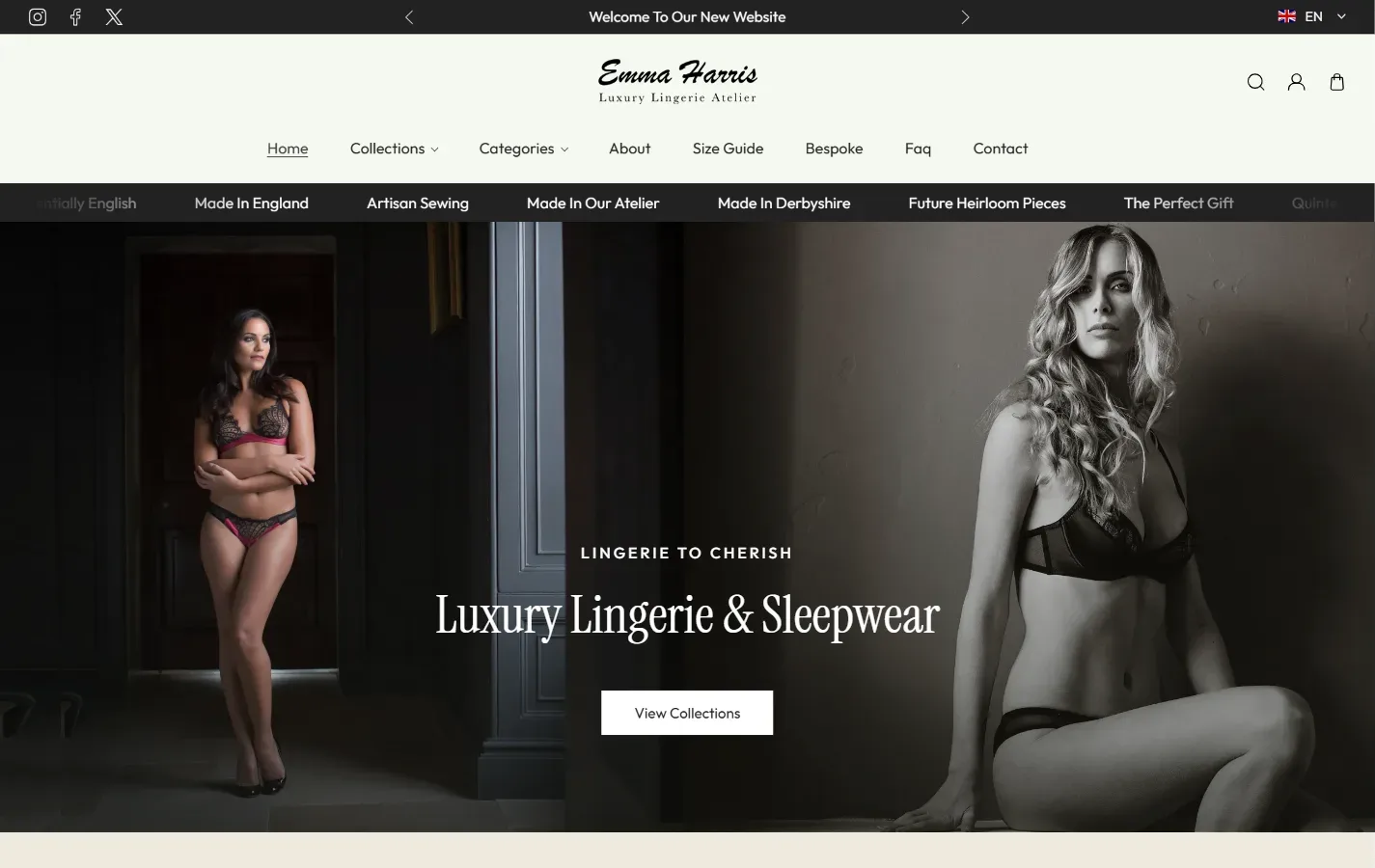 Emma Harris LingerieA luxury store with collections, colours and sizes the team now manages without a developer.
None of these is a Shopify store, and they're build results rather than organic revenue figures. We'd rather tell you that than borrow someone else's numbers.
"Amazing service, produced an amazing ecommerce website for us! exactly what we were looking for, always available to contact, very happy! Thanks Amit!" Hannah Hawkins, Google review
Shopify SEOquestions,answered
Not covered here? Call and ask. We reply within 24 hours.
Does Shopify offer SEO services?
Not as a service. Shopify gives you the tools: editable titles and descriptions, a sitemap, canonical tags, redirects and basic product markup. Someone still has to plan collections, write the copy, finish the structured data and build links. That's your team, a freelancer or an agency.
Is Shopify good for SEO?
Yes, when it's set up properly. It's fast and secure by default and handles sitemaps and canonical tags for you. Its limits are a fixed URL structure, thin default collection pages, unfinished product markup and the scripts apps add. All of those are fixable without leaving Shopify.
Can I change Shopify's /products/ and /collections/ URLs?
No. The prefixes are fixed. You can edit the handle after them (for example /collections/waterproof-walking-boots), and Shopify offers to create a redirect when you change one. Changing handles on pages that already rank should be planned, not done in bulk.
Do I need an SEO app?
Usually not for the basics. Titles, descriptions, alt text and redirects are built into Shopify. Apps can help with structured data or bulk edits, but each one adds code, so we only recommend one when it does something the theme can't.
How long does Shopify SEO take?
Technical fixes show in Search Console within weeks. Collection rankings and organic orders typically build over three to six months, longer in crowded categories or for a new store with no history.
How much does Shopify SEO cost?
With us, £1,000–£4,000 a month excluding VAT, depending on catalogue size, markets and content. A one-off audit starts at about £300 for a small site.
Should I hire Shopify SEO experts or a general SEO agency?
Hire whoever can explain Shopify's specific limits (URL structure, collection-aware links, robots.txt.liquid, Markets) and show ecommerce work. Ask any Shopify SEO expert for a written plan for your store and how they'll report on revenue, not just rankings.
Will you change my theme?
Only where it affects search, and always on a duplicate theme you can preview first. We don't redesign your store unless you ask us to.
Find out what your Shopify store is leaving on the table
Send us your store's address. We'll run the checks above and reply with the three issues costing you the most organic orders, and an honest view of what fixing them would cost.
This page is part of our ecommerce SEO and SEO services.
- 0115 647 0444
- contact@vimanadigital.com
- Available 24/7
- 1 Union Street, Long Eaton, Nottingham NG10 1HH